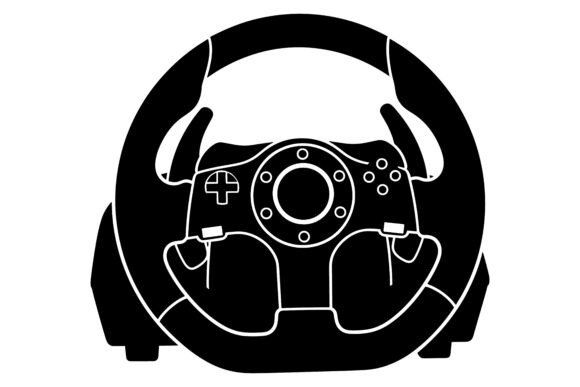
Understanding the Gaming Racing Wheel Silhouette and Its Role in Virtual Driving Projects
When you browse design marketplaces, creative asset libraries, or vector graphic collections, you will likely encounter a gaming racing wheel silhouette packaged as a downloadable resource. The typical offering includes 1 EPS file and 1 JPG file, giving both scalable vector and raster preview options in a single zip folder. At first glance, this might seem like a simple icon or clipart item. But for anyone working on sim racing overlays, YouTube thumbnails, Twitch panels, apparel mockups, or interface design, the file format decision and the visual style of the silhouette directly shape how the asset performs in real projects.
This article explores what a gaming racing wheel silhouette for virtual driving actually provides, how it differs from similar graphic resources, where it fits best, and when you may be better served by an alternative approach. The goal is to give you a grounded understanding so you can evaluate whether this type of asset aligns with your specific use case.
What a Gaming Racing Wheel Silhouette Actually Is
A gaming racing wheel silhouette is a simplified, solid-shape representation of a force feedback wheel, often shown with paddle shifters, a central hub, and a curved rim profile. Unlike a detailed photograph or a fully rendered 3D icon, the silhouette strips away texture, color gradients, and internal details. What remains is the recognizable contour of a sim racing peripheral rendered in a single fill color, typically black, white, or a custom hue depending on the user's editing choices.
The key distinction lies in the word silhouette. A standard gaming wheel vector might include spokes, button clusters, stitching lines, and LED indicator shapes. A silhouette deliberately omits those interior elements or reduces them to cutout voids against the solid fill. This makes the graphic immediately usable as a bold visual marker—something that reads clearly at small sizes on mobile screens, or as a watermark on video content, or as a die-cut shape for merchandise printing.
When a product includes 1 EPS file and 1 JPG file, the buyer receives two fundamentally different formats. The EPS (Encapsulated PostScript) file is a vector format. It can be opened in Adobe Illustrator, CorelDRAW, Affinity Designer, or Inkscape and scaled to billboard dimensions without pixelation. The JPG (Joint Photographic Experts Group) file serves as an instant raster preview—immediately viewable on any device and ready for quick placement in presentations, social media posts, or documents without needing specialized software.
EPS vs. JPG: Understanding the Format Tradeoffs
One of the most practical comparisons a buyer needs to make involves these two file formats themselves. They serve different purposes, and neither is universally superior.
The EPS Advantage
An EPS file holds vector paths. For a gaming racing wheel silhouette, those paths define the outer rim arc, the base shape, and any negative space cutouts for paddle shifters or structural arms. Because the image is defined mathematically rather than by pixels, you can resize the silhouette to fit a large-format banner, a T-shirt print, or a sticker sheet without losing sharpness. You can also change the fill color with a single click, convert the silhouette to outlines for laser engraving, or import it into motion graphics software to animate the shape.
If you are designing a Twitch overlay package and need the wheel silhouette to match your brand colors across multiple scenes, the EPS file is the right starting point. Professional designers gravitate toward vector formats for this exact reason: flexibility without degradation.
The JPG Convenience
A JPG file is a raster image composed of pixels at a fixed resolution. The included JPG file might be 3000x3000 pixels or 5000x5000 pixels depending on the seller, but it has a hard limit. Zoom in too far, and you will see jagged edges or compression artifacts. However, the JPG is instantly usable. Drag it into Canva, PowerPoint, or a Discord server banner and it works. No file conversion, no compatibility concerns with older software versions, no learning curve required to open it.
The tradeoff is clear. If you need maximum adaptability and plan to modify the graphic, the EPS file is essential. If you need a ready-to-use image for quick content creation and the native resolution meets your output needs, the JPG file is genuinely sufficient. A gaming racing wheel silhouette for virtual driving 1 EPS file 1 JPG file bundle gives you both paths, which is the practical middle ground many users prefer.
Comparing Silhouettes to Detailed Wheel Illustrations
A gaming racing wheel silhouette sits in a different visual category than a fully illustrated wheel icon or a 3D-rendered asset. Each category serves different communication goals.
A detailed illustration might show a recognizable brand-shaped wheel with textured grips, metallic flappy paddles, and a visible quick-release hub. That level of detail works well for product reviews, comparison articles, or e-commerce listings where accuracy and realism matter. A silhouette, by contrast, communicates the idea of sim racing rather than a specific product. It is more abstract, more iconic, and often more versatile across design languages.
For stream graphics and esports branding, silhouettes hold a practical edge. They adapt to monochrome color schemes, work as watermarks over gameplay footage without distracting, and create consistent visual rhythm across multiple design assets. A hyper-detailed wheel graphic might clash with minimalist stream overlays or become illegible when reduced to a 50-pixel icon for a Discord role badge. The silhouette avoids these problems by design.
On the other hand, if your project requires viewers to instantly identify a specific wheel model—say, for a product spotlight video—a silhouette cannot deliver that specificity. It signals category membership rather than model identification. Understanding this distinction helps you avoid picking the wrong type of resource for your creative brief.
Strengths and Best-Fit Scenarios for the Silhouette
Several strengths make a gaming racing wheel silhouette a sound choice for particular use cases. Recognizing those scenarios saves time and improves creative output quality.
- Stream overlay design. Silhouettes create subtle, professional branding elements that do not compete with gameplay footage for viewer attention.
- Apparel and merchandise mockups. A single-color vector shape transfers cleanly to screen printing, vinyl cutting, and embroidery digitizing without the complexity of separating multiple ink layers.
- App iconography. Mobile racing apps, companion software for sim hardware, and community Discord servers benefit from bold, recognizable silhouette icons that remain clear at small sizes.
- Thumbnail templates. YouTube and Twitch thumbnail designers frequently place silhouette shapes behind text or subject cutouts to create depth without visual noise.
- Presentation slides. Corporate pitching decks for esports sponsorships or sim racing product launches use silhouette graphics to maintain polish without overwhelming data points.
In each of these cases, the EPS file becomes the production-ready workhorse, while the JPG serves as a quick reference or placeholder during early-stage drafting. The combination reduces workflow friction.
Limitations and When to Look Elsewhere
No single graphic resource fits every project, and a gaming racing wheel silhouette has clear limitations worth acknowledging.
If you need photorealistic product representation, the silhouette will feel too abstract. Product page headers for a sim racing hardware retailer, for example, usually demand actual product photography or high-fidelity renders. A silhouette cannot convey material quality, button layout specifics, or the visual weight of a physical device in a way that convinces a buyer to make a purchase decision.
For instructional content—such as setup guides or button-mapping tutorials—silhouettes lack the internal reference points users need. A viewer trying to locate the share button or adjust the paddle shifter angle on a specific wheel base needs a diagram with labeled internal features, not a uniform solid shape.
Similarly, if your creative project spans multiple racing disciplines and needs distinct wheel types—an open-wheel formula rim, a deep-dish drift wheel, and a standard round GT rim—a single generic silhouette may not provide enough variety. In that context, a bundle of multiple silhouette styles or a set of detailed vector illustrations with visible differences might serve better. The asset including 1 EPS file and 1 JPG file is typically a single design, and its value depends on how well that one shape matches your content needs.
Evaluating Quality Before Purchase
Buyers comparing silhouette assets across different platforms benefit from a consistent evaluation framework. Look carefully at the available preview images. A well-crafted gaming racing wheel silhouette shows smooth arc curves on the rim, proportionally accurate pedal base shapes if included, and thoughtful handling of negative space. Jagged anchor points, uneven curves, or awkward proportions become painfully obvious once the shape is enlarged for print or display use.
Check whether the EPS file is properly constructed. Some sellers offer auto-traced bitmap conversions that produce unnecessarily complex path structures with thousands of unnecessary anchor points. A professionally built silhouette keeps paths clean and minimal, making the file lightweight and easy to edit. The included JPG preview often reveals whether edge quality holds up—if the preview looks soft or artifact-ridden at its native resolution, the vector original may still be salvageable, but it signals a lack of attention from the creator.
Licensing terms also factor into the practical value. Not all EPS and JPG bundles permit commercial use, print-on-demand applications, or logo usage. Verify that the license aligns with your intended deployment, especially for merchandise or broadcast use where legal clarity matters.
Making the Right Choice for Your Project
The decision to use a gaming racing wheel silhouette for virtual driving ultimately depends on balancing three factors: visual abstraction level, production format requirements, and long-term adaptability needs.
If your project thrives on bold, iconic shapes and you work across digital and print media, the EPS file provides lasting utility. The silhouette scales with your ambitions—from a small social media badge to a large event backdrop. The accompanying JPG file handles quick-turnaround needs without software dependencies.
If your project requires granular detail, multiple wheel styles, or photorealistic fidelity, a silhouette is likely supplementary rather than central. It might still serve as a background element or a transitional graphic, but it will not anchor the visual narrative alone.
There is a middle path many experienced designers take. They use silhouette assets for structural branding elements—consistent icons, divider graphics, watermark placement—while pairing them with detailed imagery elsewhere in the layout. This creates contrast and hierarchy without forcing one asset type to do work it was never designed to handle. The gaming racing wheel silhouette functions best when its role is clearly defined and its limitations are accepted rather than fought against.
Ultimately, owning a clean vector silhouette and its raster companion gives you an option—a flexible design tool that can quickly adapt to unexpected needs during content production. Whether it becomes your primary visual or a supporting element depends entirely on the creative and communicative demands of your specific sim racing or virtual driving project.